Article: How to Choose a Wedding Dress: A Complete Guide from a Designer & Lake Como Wedding Photographer

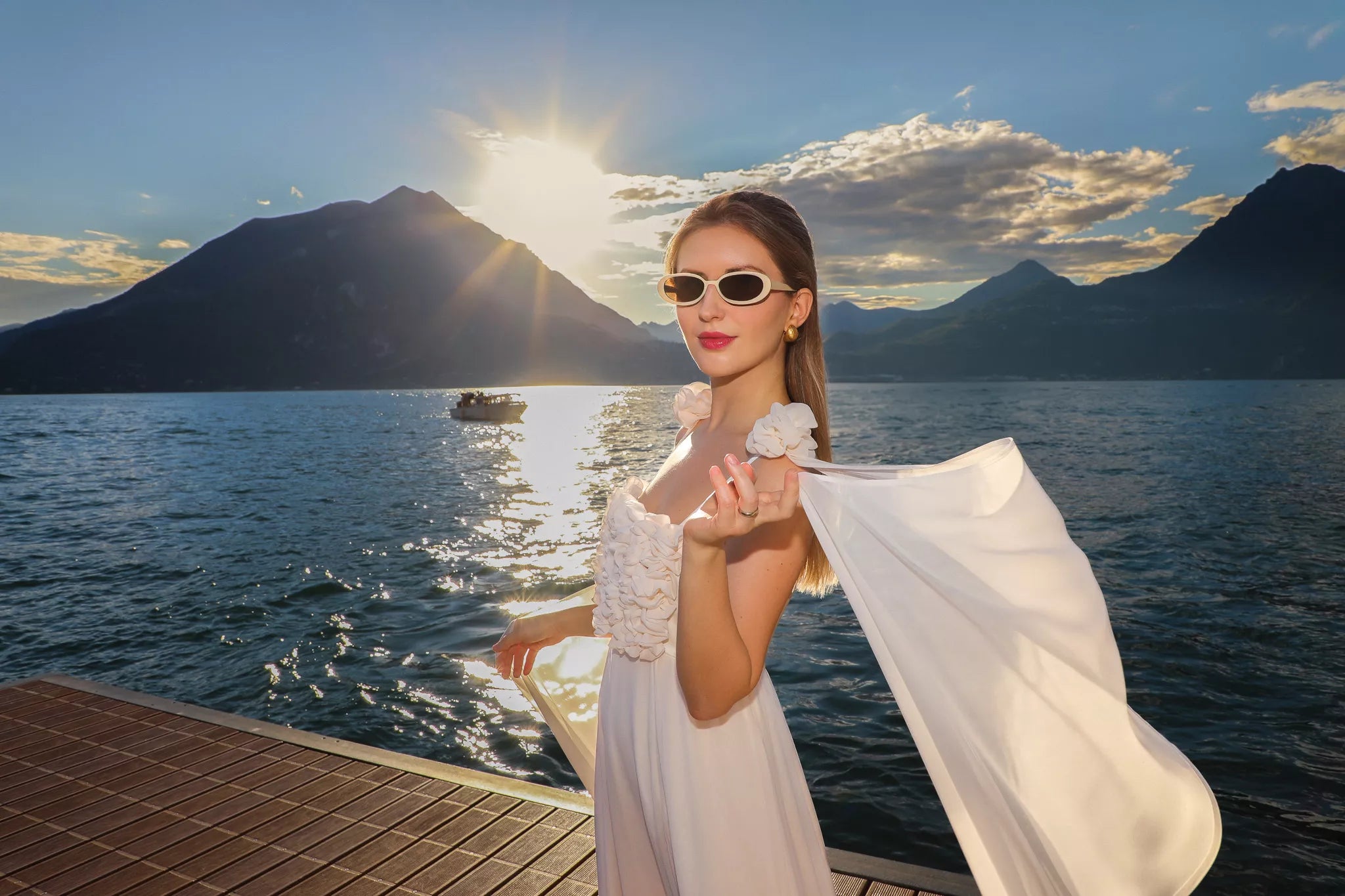
How to Choose a Wedding Dress: A Complete Guide from a Designer & Lake Como Wedding Photographer
By Nadia Fraqair, Founder & Designer of FRAQAIR
Choosing a wedding dress is often presented as a question of silhouette: A-line, mermaid, ball gown, column, fit-and-flare.
I believe the question should be much more personal.
How do you want to feel when you are wearing it?
I have photographed brides on Lake Como for years, watching them walk through historic villas, step onto boats, move through gardens, dance beneath the stars and stand beside the water as the light changes. At the same time, as the founder and designer of FRAQAIR, I create dresses with a very different understanding of the wedding gown: not simply something beautiful to look at, but something that must move with a woman.
This perspective has taught me something important.
A wedding dress can look extraordinary on a hanger and still be completely wrong for the bride wearing it.
The right wedding dress is the one that becomes part of you.
It should allow you to walk naturally, sit comfortably, embrace your partner, dance, climb stairs, move through your venue and enjoy your wedding without constantly thinking about your clothes. And, of course, it should photograph beautifully—not only in a perfectly posed portrait, but in the spontaneous moments that you will remember for the rest of your life.
This is particularly important for a destination wedding on Lake Como.
The landscape is constantly moving. The water moves. The breeze moves. The boat moves. The silk moves. The light moves.
Your wedding dress should move too.
So, if you are wondering how to choose a wedding dress, I would begin somewhere different from the usual bridal checklist.
Begin with yourself.
1. Start with the feeling, not the dress
Before saving hundreds of wedding dresses on Pinterest, Instagram or bridal websites, ask yourself three questions:
How do I want to feel?
How do I want to look?
How do I want to be remembered?
These are not necessarily the same thing.
You might want to feel completely comfortable but look incredibly elegant. You might want to look timeless rather than trendy. You might want your photographs to feel romantic and cinematic rather than heavily posed.
Your answers will immediately begin to define your dress.
Perhaps you imagine yourself walking beside Lake Como in a gown that catches the breeze.
Perhaps you see yourself in a structured architectural dress entering a historic villa.
Perhaps you want something minimal, sophisticated and almost impossibly simple.
Perhaps you want a dramatic skirt for the ceremony and something lighter for dinner and dancing.
There is no universal definition of the perfect wedding dress.
There is only the dress that is right for your body, your personality, your wedding and your way of moving through the day.
That is where I always begin with my brides.

2. Choose your wedding before choosing your wedding dress
Your wedding dress should belong to the environment around you.
This doesn't mean that your dress needs to "match" the venue in a literal way. I would never tell a bride that she needs a particular silhouette because she has chosen a particular villa.
Instead, think about the experience.
Are you getting married in a grand historic villa?
Are you having an intimate ceremony in a garden?
Are you taking a private boat across the lake?
Will most of your day take place outdoors?
Are you planning a summer wedding in the Italian sunshine?
Will you be walking over stone paths, climbing villa stairs or moving between several locations?
These details matter.
A dress designed exclusively for a ballroom can feel restrictive at a destination wedding where you are constantly moving.
A very heavy gown can become tiring during a long summer celebration.
A dress with an enormous train may look spectacular in a grand ceremony but become difficult when you are moving between a villa, garden, boat and dinner.
This is why destination wedding dresses require a different kind of thinking.
The dress has to travel with you.
And if you are getting married on Lake Como, I would always consider the entire day rather than just the ceremony.
3. Think about the complete silhouette
Once you understand the feeling and setting you want, begin exploring silhouettes.
The most common wedding dress silhouettes include:
A-line
An A-line gown gradually widens from the waist, creating a universally elegant shape.
It can be romantic without feeling overly traditional and works beautifully with both structured and fluid fabrics.
Ball gown
A ball gown has a fitted bodice and a fuller skirt.
It creates a strong entrance and is particularly beautiful for formal ceremonies and historic villas.
However, remember that volume comes with practical considerations. A very full skirt requires more space and can affect how easily you move throughout the day.
Mermaid
A mermaid silhouette follows the body before dramatically widening below the knee.
It is sculptural, glamorous and highly photogenic.
Because the shape is more fitted, however, comfort and construction become particularly important. You should be able to sit, walk and dance—not simply stand beautifully for photographs.
Fit-and-flare
This silhouette follows the body and gradually widens toward the hem.
It offers definition while usually providing more freedom than an extremely fitted mermaid gown.
Column or sheath
A column gown follows the body's natural vertical line.
It can be incredibly sophisticated, especially when made from a beautiful fluid fabric such as silk crepe or silk satin.
Slip or fluid gown
A fluid gown follows the natural movement of the body rather than imposing a rigid structure.
This is one of my favourite directions for destination weddings because it allows the fabric itself to become part of the visual story.
And this brings me to one of the most important decisions you will make:
the fabric.
4. Choose the fabric before becoming obsessed with the silhouette
One of the biggest mistakes I see brides make is falling in love with a silhouette without considering the material.
The same wedding dress pattern can look completely different depending on the fabric.
A structured Mikado gown and a silk chiffon gown may have the same basic silhouette, but they create completely different experiences.
Fabric influences:
-
how the dress falls
-
how it moves
-
how it feels against your skin
-
how warm it feels
-
how much structure the gown has
-
how it photographs
-
how it responds to wind
-
how easily it travels
-
how formal the dress feels
This is why fabric is not a secondary decision.
Fabric is part of the design.

5. Why I love silk for wedding dresses
When I design a wedding dress, I am interested in how the material behaves in real life.
Silk has an extraordinary quality: it can feel luxurious without necessarily looking heavy.
Depending on the weave and construction, silk can be fluid, luminous, soft, delicate or beautifully structured.
Silk charmeuse can glide over the body.
Silk chiffon can create an almost weightless effect.
Silk crepe can create a clean, sophisticated silhouette.
Silk satin can bring luminosity and depth.
And lightweight silk layers can create movement that is incredibly difficult to reproduce with heavier fabrics.
This is why I often describe the FRAQAIR approach as light as air.
I don't want a woman to feel as though she is carrying a costume.
I want the dress to respond to her.
To the way she walks.
To the breeze.
To the movement of the body.
To the light.
To the moment.
A silk wedding dress can be particularly beautiful for a Lake Como wedding because the landscape itself is so fluid.
The water reflects light.
The mountains create depth.
The gardens move with the wind.
A boat creates movement.
The dress can become part of that visual language.
6. Silk, satin, chiffon, organza, tulle or crepe?
Understanding the basic characteristics of bridal fabrics can make choosing your gown much easier.
Silk chiffon
Silk chiffon is extremely lightweight and fluid.
It is beautiful for soft skirts, overlays, sleeves and dresses designed to move.
For an outdoor summer wedding, its movement can be extraordinary.
Silk satin
Silk satin has a luminous surface and a beautiful fluidity.
It can create an elegant, luxurious appearance, particularly for minimalist gowns.
Because it reflects light, your photographer should understand how to work with it—especially in strong sunlight.
Silk crepe
Silk crepe has a sophisticated, relatively matte appearance and can skim the body beautifully.
It is an excellent choice for brides who want minimalism and elegance rather than volume.
Organza
Organza is lightweight but has more structure.
It can create beautiful volume without necessarily requiring a very heavy gown.
It is particularly effective when you want a dramatic skirt with a lighter visual feeling.
Tulle
Tulle can range from very soft and delicate to relatively structured depending on its construction and layering.
It can create romance, volume and a classic bridal feeling.
Mikado
Mikado is much more structured.
It is beautiful for architectural gowns, dramatic skirts and formal silhouettes.
If you want your dress to hold a very specific shape, this can be an excellent choice.
There is no "best" wedding dress fabric.
There is only the fabric that gives you the movement, structure, comfort and visual language you want.
7. Consider how your wedding dress will photograph
This is where my perspective as a wedding photographer changes the way I design dresses.
A wedding dress does not exist only in three dimensions.
It also exists in photographs.
And photographs see things differently from the human eye.
A dress may look beautiful when you are standing still in a fitting room. But what happens when you walk?
What happens when you turn?
What happens when the wind catches the skirt?
What happens when you sit down?
What happens when your photographer photographs you from behind?
What happens when you stand in direct sunlight?
What happens in soft evening light?
These are the questions I think about when photographing a bride.
I want to see the dress move.
A beautiful wedding photograph is not always a perfectly static portrait.
Sometimes it is the moment your veil lifts in the breeze.
Sometimes it is the train moving behind you as you walk through a garden.
Sometimes it is your skirt flowing as you step onto a boat.
Sometimes it is your dress catching the last sunlight of the evening.
These are the photographs that feel alive.
This is one reason I love lightweight fabrics so much.
Movement gives a photographer something to work with.
8. Don't choose your wedding dress only for the ceremony
Your wedding day may last eight, ten or twelve hours.
Your dress has to work for all of them.
Think about the entire sequence.
You wake up.
You get ready.
You walk to the ceremony.
You stand during the vows.
You hug your family.
You take photographs.
You walk through the gardens.
You travel to your reception.
You sit at dinner.
You dance.
You may even leave the venue under the stars.
Now ask yourself:
Can I imagine wearing this dress for all of that?
If the answer is no, you may want to consider a second look.
A second wedding dress does not necessarily need to be dramatically different.
It could simply be lighter.
A structured ceremony gown can become a fluid silk dress for dinner.
A long train can be removed.
A detachable overskirt can transform the silhouette.
A veil can become a cape.
Sleeves can be removed.
This allows you to have the dramatic entrance you dreamed of without sacrificing comfort later in the evening.

9. How to choose a wedding dress for a Lake Como wedding
Lake Como deserves special consideration because the location naturally encourages movement.
Imagine your wedding day as a sequence of scenes.
A morning in a historic villa.
A ceremony surrounded by gardens.
Portraits beneath ancient trees.
A walk toward the water.
A private boat.
The lake stretching behind you.
A sunset aperitivo.
Dinner on a terrace.
Each scene creates a different relationship between the bride and her dress.
For this reason, I often recommend that Lake Como brides think about lightness and movement.
This doesn't mean that every Lake Como bride should wear a simple silk slip dress.
It means the dress should allow you to experience the location.
If you want to walk beside the lake, your dress should allow you to walk.
If you want photographs on a boat, the gown should work with the boat.
If you want photographs in the garden, the fabric should interact beautifully with natural light.
If you are getting married during the warm Italian summer, comfort becomes even more important.
A wedding dress should never make you spend your wedding day thinking:
"I can't wait to take this off."
10. Choose a wedding dress that fits your body—not an imaginary body
Your wedding dress should be designed around you.
Not around a standard sample size.
Not around a photograph you saved because you liked the model's body.
Not around what you think a bride "should" look like.
Your body is not something that needs to be corrected by a wedding dress.
The purpose of the dress is to understand your proportions and create harmony.
Pay attention to:
-
your natural waist
-
your shoulders
-
your neckline
-
your posture
-
your height
-
the length of your torso
-
how you naturally move
A talented designer can use proportion to create balance.
The neckline can change how the upper body appears.
The waist position can change the visual length of the legs.
The skirt volume can alter the relationship between the body and the gown.
The placement of seams can create an incredibly elegant line.
This is why I believe made-to-measure design is so powerful.
The dress begins with the woman.
Not the other way around.
11. Don't choose a dress because it is "flattering"
I would actually encourage you to be careful with the word flattering.
A dress can be flattering and still not feel like you.
You should ask:
Does this dress make me feel beautiful?
Can I breathe?
Can I move?
Do I feel like myself?
Do I feel comfortable being photographed in it?
Can I imagine my partner seeing me in this dress?
There is a difference between looking good and feeling extraordinary.
Your wedding photographs will capture your face, your posture and your emotions.
If you feel uncomfortable, that discomfort can become visible.
If you feel confident, relaxed and completely yourself, that becomes visible too.
The most beautiful bride is rarely the bride wearing the most complicated dress.
She is the bride who has forgotten about the dress because she is completely immersed in the moment.
12. Think about the neckline
The neckline is one of the first things people notice in a wedding portrait.
It also frames your face.
Common options include:
-
sweetheart
-
straight
-
square
-
bateau
-
V-neck
-
halter
-
off-the-shoulder
-
asymmetric
-
high neckline
Don't choose purely according to trends.
Think about the relationship between the neckline, your face, shoulders, hairstyle and jewellery.
And think about your wedding photography.
A clean neckline can be incredibly elegant in close portraits.
A more dramatic neckline can create a stronger editorial image.
A soft neckline can work beautifully with loose hair and a romantic setting.
The best choice is the one that creates harmony rather than competing for attention.
13. Think carefully about the back of the dress
One of my favourite details to photograph is the back of a wedding dress.
Why?
Because brides spend a surprising amount of time being photographed from behind.
Walking away from the ceremony.
Walking through a garden.
Standing beside the lake.
Entering a boat.
Walking toward their reception.
The back of the gown can therefore be as important as the front.
A low back, delicate buttons, a bow, a sculptural neckline, silk draping or an elegant train can create an extraordinary image.
When trying on a wedding dress, always turn around.
Ask your consultant to photograph you from behind.
Walk away.
Look at the dress in motion.
You may discover that the gown you loved from the front is not the one that makes your heart stop from behind.
14. Your veil is part of the wedding dress
A veil should not be treated as an afterthought.
It changes the entire silhouette.
A cathedral veil creates drama.
A soft fingertip veil can feel romantic and effortless.
A long silk veil can create beautiful movement.
A veil with subtle details can complement a minimalist gown without overwhelming it.
For a Lake Como wedding, I particularly love veils that interact with the wind.
There is something magical about seeing a translucent veil lift above the lake while the bride walks.
It creates photographs that could never be created in a studio.
But again, the veil should work with the dress.
If the gown already has significant detail, a simpler veil may be more elegant.
If the dress is extremely minimal, the veil can become the dramatic element.
15. Consider your shoes—but don't let them dictate the dress
Your shoes need to be beautiful, but they also need to be practical.
This is particularly important for destination weddings.
Lake Como can involve stone paths, gardens, stairs, boats and uneven surfaces.
Your shoes should allow you to move confidently.
And remember that your dress length should be fitted with the shoes you actually intend to wear.
If you are planning a second pair for dancing, discuss this with your seamstress.
A few centimetres can make a major difference.
16. How much should a wedding dress weigh?
This is a question more brides should ask.
Not because a heavier dress is automatically worse.
It isn't.
Some brides want the sensation of a dramatic, structured gown.
But if your wedding involves travel, walking, outdoor portraits and a long celebration, weight becomes an important part of comfort.
Ask:
How much does the complete dress weigh?
Not just the fabric.
The entire gown.
The corset.
The lining.
The skirt.
The embroidery.
The layers.
The train.
The embellishments.
Then imagine wearing all of it for ten hours.
For a destination wedding, I often prefer the visual impact of a dress that looks luxurious without physically feeling heavy.
That is one of the reasons natural silk is central to my design philosophy.
17. When should you buy your wedding dress?
Do not leave your wedding dress until the last minute.
A custom or made-to-measure wedding dress requires time for design, fabric sourcing, construction and fittings.
For a bespoke gown, I recommend beginning the conversation well before the wedding.
The exact timeline depends on the designer, complexity of the gown, number of fittings and destination.
If you are considering a custom FRAQAIR wedding gown, the process begins with a consultation rather than choosing a size from a rack.
The goal is to understand you first:
your wedding,
your location,
your body,
your movement,
your personal style,
and the experience you want to have.
Only then does the design begin.
18. Bring the right people to your bridal appointment
Your wedding dress appointment should be exciting—not overwhelming.
You do not need ten opinions.
In fact, too many opinions can make the process much harder.
Bring one or two people whose taste you genuinely trust.
And remember:
You are the bride.
Your mother may love one dress.
Your best friend may prefer another.
Your partner may have a completely different idea.
But you are the person who has to wear it.
The final decision should be based on how you feel.
19. Take photographs during every fitting
This is especially important.
A dress can look completely different in photographs than it does in a mirror.
Take photographs from:
-
the front
-
the side
-
the back
-
close-up
-
full length
-
walking
-
sitting
-
turning
If possible, also record a short video.
Watch how the fabric moves.
Watch how the train behaves.
Watch how the neckline moves.
Watch how the dress responds when you walk.
This is one of the simplest ways to make a more informed decision.
20. The most important wedding dress test: forget about the dress
There is one test I always recommend.
Put on the gown.
Look in the mirror.
Then stop thinking about the gown.
Talk.
Walk.
Laugh.
Sit.
Turn.
Imagine your partner standing in front of you.
Imagine your father, mother or closest friends seeing you.
Imagine walking toward your ceremony.
Imagine being photographed.
Imagine dancing.
Then ask yourself:
Do I feel like myself?
If you suddenly stop thinking about whether the dress is "perfect" and start imagining your wedding day, pay attention.
That may be your dress.
21. My philosophy as both a designer and wedding photographer
Being both a designer and a photographer has changed the way I see wedding dresses.
As a photographer, I see what happens when a bride moves.
I see which fabrics catch the wind.
I see which silhouettes create beautiful lines.
I see what happens when sunlight touches silk.
I see the difference between a dress that photographs beautifully while standing still and a dress that creates movement throughout an entire story.
As a designer, I think about construction.
How the fabric falls.
How the seams shape the body.
How the gown supports movement.
How the dress feels after hours of wearing it.
These two perspectives meet in every FRAQAIR gown.
I don't want to design dresses that only look beautiful in a fitting room.
I want to design dresses that become more beautiful when life happens.
When you walk.
When you laugh.
When you run toward your partner.
When the wind catches the skirt.
When the sun disappears behind the mountains.
When you step onto the boat.
When you dance.
When you forget that someone is photographing you.
That is when I believe a wedding dress becomes truly beautiful.
22. The best wedding dress is the one that lets you live your wedding
If you remember only one thing from this guide, let it be this:
Do not choose your wedding dress only for the photograph you imagine taking at the altar.
Choose it for the entire day.
Choose it for the woman you are.
Choose it for the way you move.
Choose it for the climate.
Choose it for the location.
Choose it for the photographs.
Choose it for the memories.
And if you are planning a destination wedding on Lake Como, allow the landscape to become part of the experience.
Let the dress move with the lake.
Let the fabric respond to the Italian light.
Let your veil catch the breeze.
Let your skirt move as you walk through the gardens.
Let your photographs capture not just how your wedding dress looked, but how it felt to wear it.
Because years from now, you will not remember every detail of the fitting appointment.
You will remember how you felt when you saw your partner.
You will remember walking toward them.
You will remember the sunlight.
The lake.
The music.
The people you love.
The movement of your dress.
And the moment when you realized:
this is my wedding day.
That is what I want every FRAQAIR bride to feel.
Not dressed up.
Not disguised.
Not restricted.
But completely, effortlessly herself.
Light as air.
Aria - Silk Chiffon Wedding Dress

Frequently Asked Questions About Choosing a Wedding Dress
How do I choose the right wedding dress?
Start with your wedding location, season, personal style and the way you want to feel. Then consider silhouette, fabric, neckline, movement, comfort and fit. The right dress should work with your body and your wedding day rather than simply looking beautiful on a hanger.
What is the best fabric for a wedding dress?
There is no single best fabric. Silk, satin, chiffon, crepe, organza, tulle and Mikado all create different effects. For brides seeking a lightweight, fluid and luxurious destination wedding dress, silk is particularly beautiful because of its natural drape and movement.
Is silk a good fabric for a wedding dress?
Yes. Different silk weaves offer different characteristics, from fluid chiffon and crepe to luminous satin. Silk is particularly beautiful when movement, comfort and natural elegance are priorities.
What wedding dress is best for a destination wedding?
A destination wedding dress should consider the climate, venue, transportation and amount of movement during the day. Lightweight fabrics and thoughtfully constructed silhouettes can be especially practical for outdoor destination weddings.
What wedding dress is best for a Lake Como wedding?
There is no single Lake Como wedding dress style, but gowns that allow natural movement can work exceptionally well with the lake's gardens, villas, boats and outdoor settings. Lightweight silk, fluid silhouettes and elegant trains can create beautiful movement in Lake Como's natural light.
When should I start looking for my wedding dress?
Begin early, particularly if you want a custom or made-to-measure gown. Bespoke dresses require time for design, fabric selection, construction and fittings. Your designer should give you a specific timeline based on the complexity of your gown and wedding date.
Should my wedding dress be comfortable?
Absolutely. You will potentially wear your wedding dress for many hours. You should be able to walk, sit, embrace, dance and enjoy your celebration. Comfort should not mean sacrificing elegance; good design should combine both.
Should I choose my wedding dress based on my body type?
Body-type rules can be useful as a starting point, but they should never dictate your choice. Your proportions, personality, movement and preferences are more important than following rigid rules about what a bride "should" wear.
Should I have a second wedding dress?
A second dress can be wonderful if you want a dramatic ceremony gown and something lighter for dinner or dancing. It is not necessary, however. A well-designed gown can sometimes be transformed with a detachable train, overskirt, sleeves or veil.
What should I bring to a wedding dress appointment?
Bring inspiration images, appropriate undergarments, the shoes you expect to wear if available, and one or two trusted people. Most importantly, bring an open mind. A fabric or silhouette can look completely different on your body than it does in a photograph.
A final note from Nadia
I believe a wedding dress should never compete with a woman.
It should reveal her.
That is why I design with natural silk, movement and light in mind.
And it is why my experience as a wedding photographer continues to influence the way I create dresses.
I know what happens after the fitting room.
I know how a gown behaves when a bride walks through a garden.
I know how silk looks beside the lake at sunset.
I know how a train moves when she walks toward her partner.
I know which details will still matter in photographs twenty years from now.
And ultimately, that is what I want FRAQAIR to create:
wedding dresses made not only to be seen, but to be lived in.
If your wedding is taking you to Lake Como, Italy or another destination where the landscape is part of your story, your dress should belong to that journey.
It should move.
It should breathe.
It should feel like you.
Light as air.
— Nadia Fraqair
Founder & Designer, FRAQAIR
Wedding Photographer & Destination Wedding Specialist

Written by Nadia Fraqair
Leave a comment
This site is protected by hCaptcha and the hCaptcha Privacy Policy and Terms of Service apply.